Preview in:
1. How to access the API?
2. Limitations
3. API panel
4. API integration
5. Who can use lenso.ai’s API?
How to access the API?
- To access lenso.ai’s Reverse Image Search API, you need to purchase a subscription. To do that, visit the pricing page and purchase the Developer plan.
- You can access the API panel tab from your user dashboard.
If you want to use facial search* in API, you have to sign an agreement first. You will be able to download it anytime.
*Available in selected regions
Limitations
- Starting off, you will receive 1000 API requests, however, you can request up to 5000 requests via the contact form. Explain your use case, and we will adjust the requests number accordingly.
- You can’t send over 2 API requests per second.
The limitations were set up only to prevent misuse of the application.
API panel
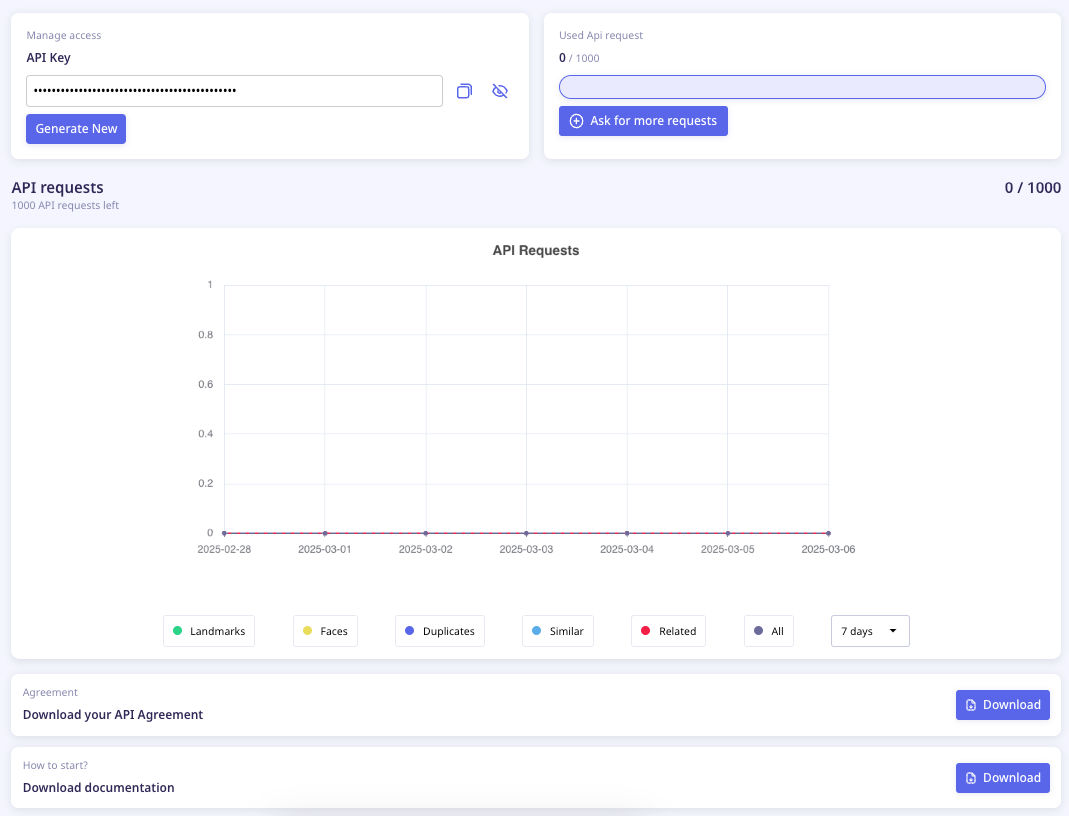
In your API panel, you’ll be able to find:
- your API key,
- number of used API requests,
- API requests chart,
- documentation,
- for regions where face search is available, you can also find your API agreement.
API Integration
To integrate the API, you need to download the documentation first. You can find it in the API panel. If you’d like to read the full documentation before subscribing, contact us.
Here are some simple steps explained in more detail in the documentation:
Authorization
All API requests require authorization using a Bearer token in the Authorization header.
Authorization: Bearer <your_access_token>
Replace with your actual access token (API Key) obtained from lenso.ai website.
Search Request
Here’s what requests parameters look like in JSON:
{
 "image": "base64-encoded string",
 "category": "string",
 "sortType": "string",
 "domain": "string",
 "page": "integer (starts from 1)"
}
And here’s what a successful response looks like:
{
  "results": [
    {
      "urlList": [
        {
          "imageUrl": "https://example.com/image1.jpg",
          "sourceUrl": "https://example.com/source1",
          "title": "Example Image 1"
        }
      ],
      "base64Image": "iVBORw0KGgoAAAANSUhEUg..."
    }
  ],
  "availablePages": 5
}
Who can use lenso.ai’s API?
Lenso.ai's Reverse Image Search API has multiple use cases across different industries. Here are some key applications:
1. Visual Search in E-Commerce Apps
- Allow users to upload an image to find visually similar products.
- Improve product discovery without relying on text-based search.
2. Fake Profile & Scam Detection in Social Media Apps
- Verify profile pictures to detect duplicates or stolen images.
- Prevent catfishing and identity fraud by scanning uploaded photos.
3. Copyright & Brand Protection
- Detect unauthorized use of brand images or copyrighted photos.
- Automate content takedown requests for stolen or misused images.
Of course, these are just three most common cases, but lenso.ai can be used in hundreds of applications.
More questions? Contact us!
We can make a tailored plan for your business, help you with API integration, adjust the number of API calls and more! Contact us here:

Author
Kinga Jasinska
Marketing Specialist
Continue reading

Guides
How to find the perfect fall photoshoot location from a photo?
Fall is the perfect time for a new photoshoot, whether you want to create fresh content for your personal social media accounts or promote your product or brand with an authentic fall vibe. But first, you need to find the right place. Find out how to discover the perfect fall photoshoot location from a photo.

Guides
What to do in the first ten minutes after you find your own face in a reverse image search?
Finding your own face in a reverse image search is a strange feeling. Not usually because the result is sinister, most of the time it is a conference photo, an old profile picture, a team page from a job you left in 2019, but because you did not put it there and you did not know it was there.
Guides
Is your match real? Reverse image search a dating profile
Dating apps are probably the go-to solution for finding a potential date, but unfortunately, they can also be one of the riskiest options. How can you make sure your match is real? Do a reverse image search and find more information using their dating profile picture.