
Preview in:
So you open three tabs and read three landing pages. They tell you the same story. Fast. Powerful. AI-driven. Built for professionals. Nothing on any of those pages tells you which one will answer the question you actually have.
That is the gap worth closing before you commit, because in this category an empty result has several meanings, and only one of them is the tool telling you the truth about the world.
A landing page describes the category, not the product
Marketing pages are written one level above the product. "Reverse image search" describes an input and an output: you give a picture, you get places it appears. That is true of every tool in the category, which is why it cannot help you choose between them. The product sentence lives one level down, in a features page, a pricing table or the terms, where a tool has to name the jobs it was built around and the ones it was not.
So write your job in one sentence before you compare anything. "Find every page where this face appears." "Prove this photo existed before that date." Those are different jobs, and a tool that is excellent at one can return an empty page for the other without being broken.
Every category has a failure shape
Every tool category fails in a characteristic way, and what matters is not how often it fails but whether you can see the failure.
Writing tools fail by being confidently wrong: the output arrives fluent and finished, and the error stays invisible until someone who knows the subject reads it. Analytics tools fail by being plausible, because a number that is wrong by half still renders as a clean line on a chart. Face search and reverse image search fail by silence. The screen returns an empty result, and an empty result looks identical to a correct negative. The tool cannot tell you which of the two it just handed you.
Learn the failure shape of your category before you read a pricing page, then design the one small test that would expose it. Skip that and you are not evaluating tools, you are comparing adjectives.
In face search, silence is not evidence
An empty result page here can mean any of the following, and they are not the same finding:
- The images genuinely are not on the public web.
- The images are online, but not in that engine's index.
- Some results are locked on the free plan, and unlocking is what reveals the source links.
- You searched in the wrong mode for the job you actually have.
- The feature you need is not available in your region.
Only the first is a fact about the world. The rest are facts about your instrument.
The fix is a control: run a search whose answer you already know. For mobile network checks, repeat that control through mobile proxies in a supported region, keeping the image, search mode and account unchanged so you can isolate network-related differences. If a tool cannot find what you know is there, its silence about what worries you means nothing.
A worked example: reading lenso.ai one level down
Take lenso.ai, which is a useful one to practise on because it publishes its specifics. It describes itself in category terms — an AI reverse image search with facial recognition — and the homepage promises you can "Search by image for faces, places, duplicates, related, and similar images." True, and still category-level. The product detail sits one level down, where the search modes are named individually: Place, People, Similar, Related, Duplicates and By-text.
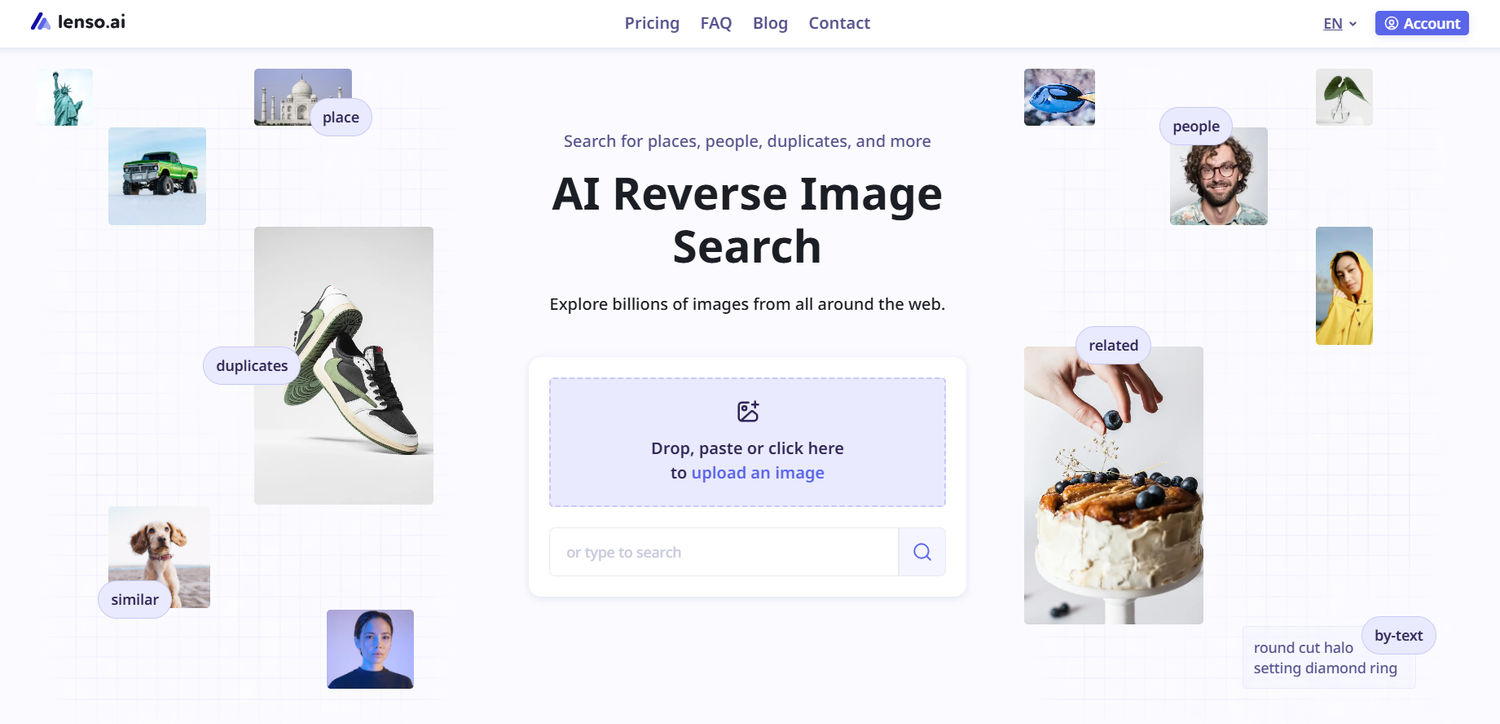
Six modes is six jobs, and the names carry the guidance. Duplicates reads as the same file reposted somewhere else, which is the provenance and image-theft job. Similar and Related read as near matches and the surrounding visual neighbourhood, so if your job is provenance rather than research, confirm they behave the way you expect before you rely on them. Place reads as location, and By-text as a text query rather than an image one. Those are the plain sense of the names, so treat them as a starting hypothesis and let one test confirm it.
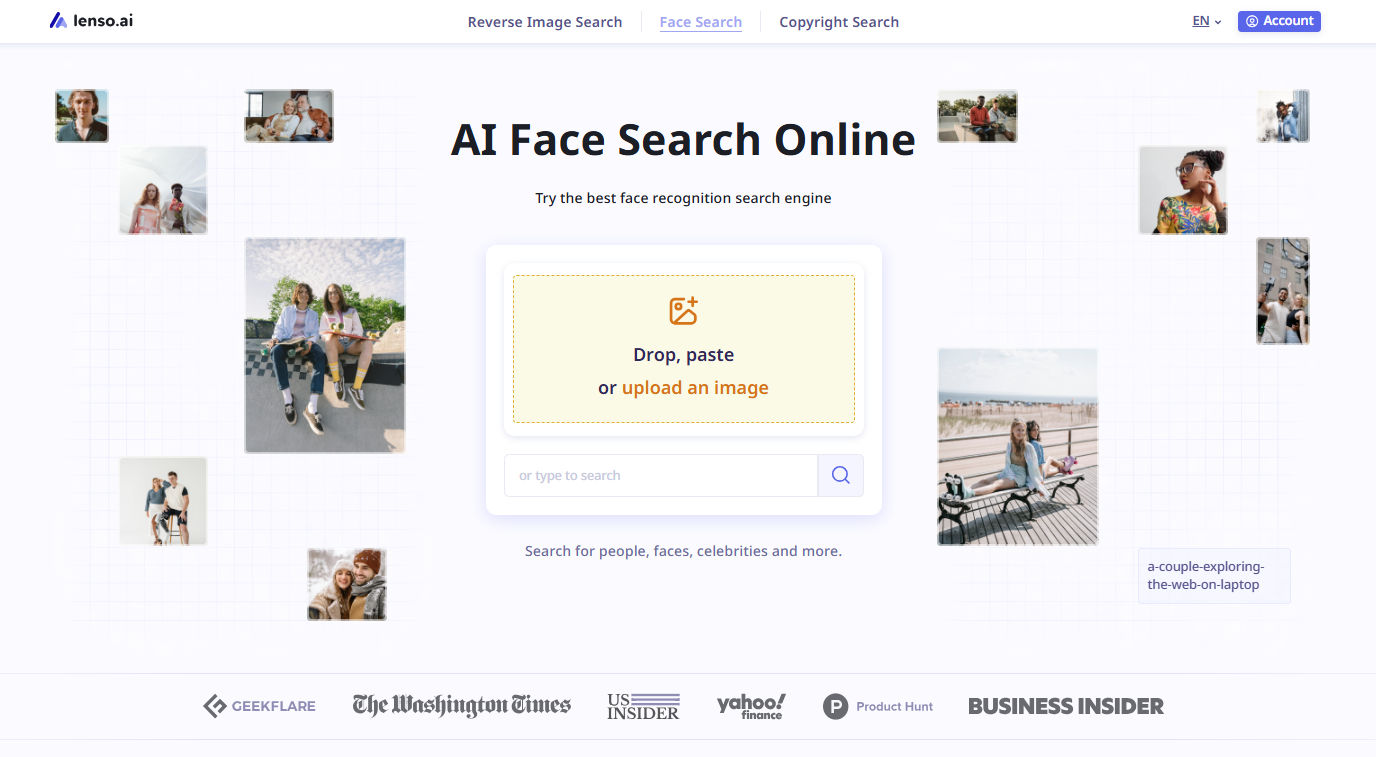
What is documented in detail is the face job. Face Search is described as "a technology based on Facial Recognition" that "allows to find celebrities and everyday people online", and there is a specific depth figure attached to it on the paid tier: with Research Mode, on the Professional plan, lenso.ai says you "get access to 10,000 results for People and Duplicates", which it describes as "10 times more pages to explore for every search". That is a real number you can hold a result against, which is more than most pages in this category offer.
The mechanism underneath is worth knowing, because it tells you what will and will not break a search. lenso.ai states that "AI reverse image search relies on deep learning and Content-Based Image Retrieval (CBIR) to match images based on visual similarity, rather than text". Visual similarity, not captions or file names. Renaming a file changes nothing. Cropping the face out of it changes everything.
Why does a duplicate search find a photo when a face search on the same photo finds nothing?
Because they are answering different questions about the same image. Your photograph reposted on a forum is the same file in a new place, which is a duplicate. A different photograph of the same person, taken at another event on another day, shares no pixels with the one you uploaded, so only a face search will surface it. Run the wrong one and the empty page is a verdict on your mode choice, not on the web.
Two of the five causes listed earlier are checkable before you spend anything, and the third is the one you can never check directly.
First, results can be present but locked. lenso.ai's free plan is defined in its terms as free of charge, available with or without an account, for individuals and non-commercial use, and it "returns a certain number of results as blocked". Unlocking is what reveals the source links, and the terms set the allowance per billing period at 50 unlocks on Starter, 500 on Professional and 5,000 on Developer. A thin-looking page can simply be a locked one.
Second, availability. lenso.ai carries an asterisk on both its homepage and its face search page: "*Facial search is available only in selected regions". If the mode you came for is not offered where you are, that is not a match quality problem, and retrying will not make it one.
Third, genuine absence, which is the answer most people want and the one to hold most loosely. No engine in this category treats its output as the last word, and the responsible ones say so in their terms. Treat any match as a lead to verify rather than as proof, whichever tool returns it.
Read the pages written for lawyers, not the one written for you
Most people ask how many searches a plan includes. In this category that is usually the wrong unit, and it produces a plan chosen on the wrong axis entirely. The most informative pages are rarely the homepage. They are pricing, terms, privacy and the API documentation, because those have to be specific. Read them and the product's real shape appears:
- Depth is a paid axis. Professional adds Research Mode and Deeper Search, which reaches matches below the top set, plus Advanced Filters — lenso.ai lists filtering by page language, domain, date range, size of the image and keyword in the title of the page.
- Monitoring is a separate axis. Alerts run to 10 on Starter, 50 on Professional and 500 on Developer, which matters more than any accuracy claim if your job is "tell me when this appears again".
- Automation carries a compliance step. Developer provides up to 5,000 API calls a month across a Reverse Image Search API and a Face Search API, and the Face Search API also requires living in a region where the feature is available and signing a separate facial search agreement. That safeguard is the responsible shape for a biometric API, and it is worth knowing before you plan a build around it.
- The privacy claims are specific enough to check. lenso.ai states it never saves or shares uploaded images and never uses them for AI training, and that uploads are visible only to the uploader. Sharing a results link changes the audience, and the same page bounds that: links stay "active only for up to 6 hours from last interaction".
- There is a published exit. Removal runs through an opt-out form, and the site states "It usually takes less than 24 hours for an image to be removed". The terms also give consumers a right to rescind within 14 days of the agreement's conclusion, provided service has not commenced, meaning no unlocked results and no active alert.
None of that is visible from a homepage, and every line of it changes what "it did not find anything" means. The terms also name the company behind the service, LENSO AI S.A. in Wrocław, Poland, so there is an entity you can write to. Read pricing, terms and privacy first, and note which promises live on a marketing page and which live in a contract. Counted properly, fifty of the right thing beats unlimited of the wrong one.
Test the failure shape before you pay
Four checks, before you enter a card:
- Run a positive control on an image you know is published on a page you can name. Use the kind of image you will really be searching with, a phone snapshot rather than a studio headshot, and run it from the country and account state you will actually use.
- Confirm you are in the mode that matches your job.
- Distinguish empty from locked before you conclude the index has nothing.
- Check availability from where you actually are, and find the removal route and the rescission window while you are still deciding.
Pass the control and a still-empty result tells you something real. Fail it, and you have learned about the tool, not about your photo. And whatever comes back, treat a match as a lead to verify rather than as proof, which is the posture every serious engine in this category asks for.
Match the tool to the job
- Someone may be using your face: lenso.ai's face search, run against a positive control first, with regional availability checked before you conclude anything.
- The same file reposted elsewhere: Duplicates, the mode whose name points at re-uploads and image theft.
- Proving where an image came from: Duplicates for the exact file, then Professional's domain filter to interrogate one site.
- Ongoing monitoring: alerts, with your tier's allowance counted against the number of images you need watched.
- Bulk or automated work: the Developer plan's two APIs, with the region and agreement step on face search.
- Getting your own images taken down: lenso.ai's opt-out form removes them from lenso.ai, which the site says usually takes under 24 hours. If a search turns up copies sitting on data brokers and other platforms, each of those runs its own process, and the opt-out library at noizz.io covers that wider step with 83 step-by-step removal guides for data brokers, platforms and ad networks, each with the steps and the company's own data request contact.
The bottom line
A landing page can only tell you which category a tool belongs to. What separates one that works for you from one that quietly does not is the failure shape of the category, and whether you ran the small test that makes the failure visible.
In face search the failure is silence, so the discipline is short. Pick the mode that matches your job, run a control whose answer you know, learn the difference between a locked result and an empty one, and read the terms before the homepage.
On the tool itself, the reason lenso.ai survives that test well is that it separates the jobs instead of blurring them. Six named modes mean a face search and a duplicate hunt are different operations rather than one button with different luck, its face search is built to find everyday people and not only public figures, and on Professional it will go 10,000 results deep on People and Duplicates when the top matches are not where your answer is. Those are capabilities you can aim, which is the thing an adjective on a landing page can never be.

Author
Pablo Diaz
Content Writer
Continue reading

Guides
How to find the perfect fall photoshoot location from a photo?
Fall is the perfect time for a new photoshoot, whether you want to create fresh content for your personal social media accounts or promote your product or brand with an authentic fall vibe. But first, you need to find the right place. Find out how to discover the perfect fall photoshoot location from a photo.

Guides
What to do in the first ten minutes after you find your own face in a reverse image search?
Finding your own face in a reverse image search is a strange feeling. Not usually because the result is sinister, most of the time it is a conference photo, an old profile picture, a team page from a job you left in 2019, but because you did not put it there and you did not know it was there.
Guides
Is your match real? Reverse image search a dating profile
Dating apps are probably the go-to solution for finding a potential date, but unfortunately, they can also be one of the riskiest options. How can you make sure your match is real? Do a reverse image search and find more information using their dating profile picture.


Guides
Can Reverse Image Search Find People?
Have you ever tried to find a person from a photo? Normal reverse image search doesn't work when it comes to images of people. It can find the same photo on different websites, but it struggles with facial recognition. Read this article to find out how reverse image search technology evolved to add facial recognition into the equation!