
Preview in:
As you may already know, reverse image search tools are designed to search using images rather than text. This makes it much easier to find the most relevant results. In addition to basic image search functions, these tools allow you to locate the source(s) of an image.
How can it be helpful?
- Verifying authenticity: check where the image was originally published and confirm whether it has been edited or taken out of context.
- Check for misinformation: check whether an image has been reused or altered for spreading false information.
- Tracking copyright violations: artists, photographers, and content creators can find sources where their images are used without permission.
- Finding higher-resolution images: designers or marketers can locate high-quality versions of images by searching for the same visual in larger formats.
- Product sourcing and shopping: consumers can use reverse image search to find products from images, find where they are sold, and compare prices.
- Checking for manipulated or filtered images: uncover whether an image has been digitally edited or passed through filters to alter its appearance.
- Academic research and sourcing: use image searches to find the original source of images that are necessary for references for their work.
How to find the source of an image with lenso.ai?
Lenso.ai is a perfect example of a reverse image searchtool where you can not only search by image but also find the original source or discover where the image has been published.
Based on that, all you need to do is upload an image and start your image search. You can then explore results in following categories:
- People
- Places
- Duplicates
- Similar images
- Related images
Finding duplicated and copied images online with lenso.ai
If you want to find where the image was originally published, simply select the image and click on the 'web icon' located beneath it.
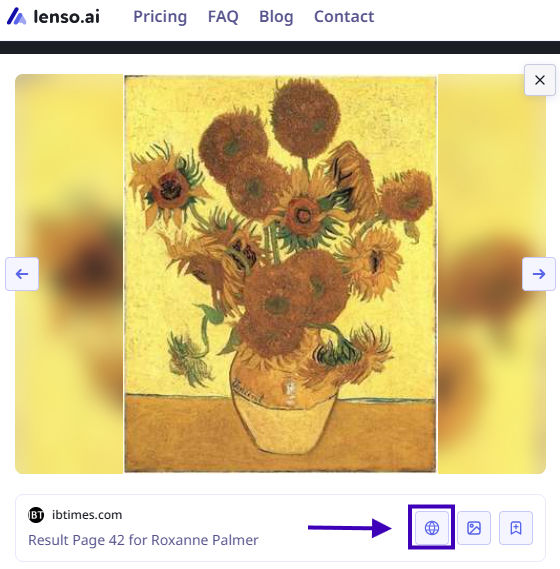
Explore additional options on lenso.ai
There is more to that! With filter and sorting options available on lenso.ai you can perform an in-depth search and find the best possible match or reassure whether your image has been duplicated, edited, filtered or somehow misused.
Filter options:
- Text - search by keywords; upload a blue mug and try the keyword “red” to find red mugs
- URL - search only on a specific website by providing its URL
Sorting options:
- Newest/Oldest - sort pictures based on the date of indexing
- Best/Worst match - sort based on how well the image matches the pictures in the index
- Random - sort randomly for more diverse results
- Show diverse results - find the same people or places in different arrangements.
Want your image removed from lenso’s index?
If you find an image that is protected by copyright law or you don't want lenso to index your face, please fill out the DSA formor submit an Opt-Out requestaccordingly.
DMCA/DSA or Opt-Out — Which Form to Choose and How to Fill Out the Request?

Author
Julia Mykhailiuk
Marketing Specialist
Continue reading

Guides
Find cozy fall aesthetics online with reverse image search
Fall is the perfect season to shop for cozy, aesthetic finds. With the internet overflowing with autumn posts and inspiration, it can be hard to narrow down what you want. How to find cozy fall aesthetics online with reverse image search?

Guides
How to find the perfect fall photoshoot location from a photo?
Fall is the perfect time for a new photoshoot, whether you want to create fresh content for your personal social media accounts or promote your product or brand with an authentic fall vibe. But first, you need to find the right place. Find out how to discover the perfect fall photoshoot location from a photo.

Guides
What to do in the first ten minutes after you find your own face in a reverse image search?
Finding your own face in a reverse image search is a strange feeling. Not usually because the result is sinister, most of the time it is a conference photo, an old profile picture, a team page from a job you left in 2019, but because you did not put it there and you did not know it was there.

Guides
Is your match real? Reverse image search a dating profile
Dating apps are probably the go-to solution for finding a potential date, but unfortunately, they can also be one of the riskiest options. How can you make sure your match is real? Do a reverse image search and find more information using their dating profile picture.