![Best Chrome Extensions for Reverse Image Search [2026 Ranking]](https://img.lenso.ai/blog/best-chrome-extensions/best-chrome-extensions?updatedAt=1749627943559&tr=w-930,h-720)
Preview in:
How can you use reverse image search?
Reverse image search can be extremely helpful in everyday tasks. It can be used for work or personal use while browsing the web. Here are just a few use cases:
- Find out whether your images appear online and if they are being misused
- OSINT investigations
- Copyright image search (check for potential misuse of your work)
- Place search (find a location from a photo)
- Check image performance (useful in marketing or SEO)
- Shop with an image
- Search for inspiration (discover similar image assets)
You need to start using reverse image search. Here's why.
If that caught your attention, it's time to explore and download the best Chrome extensions for reverse image search.
Best Chrome Extensions for Reverse Image Search [2026 Ranking]
1. Lenso.ai reverse image search
.jpg?updatedAt=1749545746403)
With the lenso.ai reverse image search Chrome extension, you can easily search for:
-
People
-
Duplicates (Copyright image search)
-
Places
-
Related or similar images
Thanks to this extension, you'll be able to:
- Search by image: right-click any image on a website and select “search by image with lenso.ai.”
- Search by selection: click the extension icon or choose “search by selection with lenso.ai” from the context menu to perform a reverse image search on any selected area of the webpage.
- Search by text: highlight any text on a website, right-click, and choose “search by text with Lenso.ai.”
2. Search by image
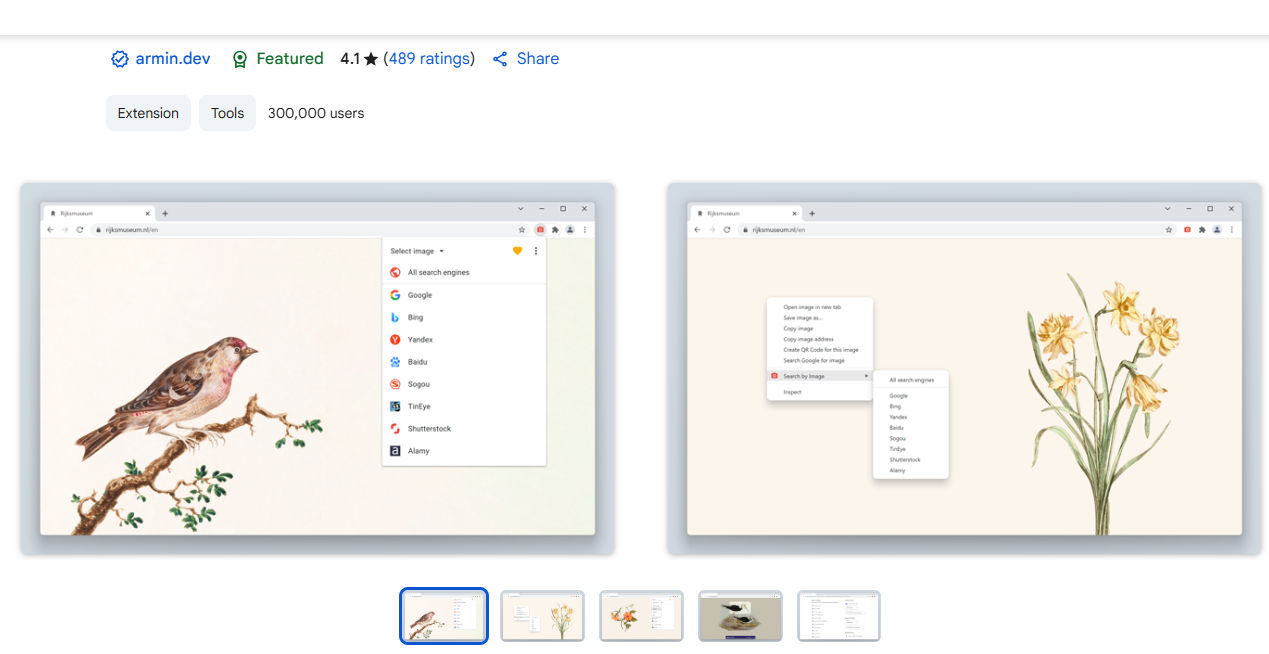
This is one of the most popular Chrome extensions for reverse image search. It includes a variety of image search tools, making it easy to check images across multiple sources.
All you need to do is right-click any image, then choose a specific image search engine or click “All search engines” to search across all of them at once.
Additionally, in the extension settings, you’ll find a full list of supported search engines, and you can customize a shortlist to suit your preferences.
3. RevEye
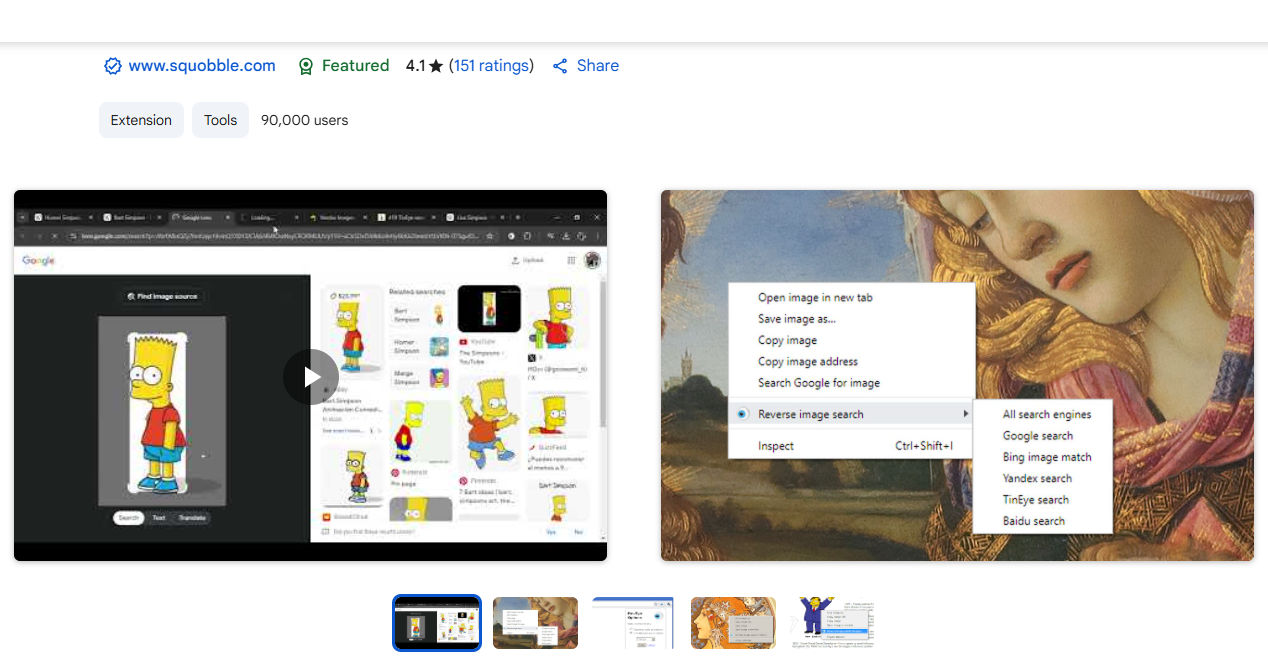
RevEye works similarly to the Search by Image extension but offers fewer image search engine options. If you're looking for something very specific, you may not find it there. However, you can add your own custom reverse image search tool.
4. TinEye
TinEye is one of the oldest reverse image search tools. It works well for general image searches and finding duplicates. However, due to its limited index, it may not provide a large number of high-quality results.
That said, it functions like most other image search extensions: just right-click on an image and view the results.
5. Facecheck
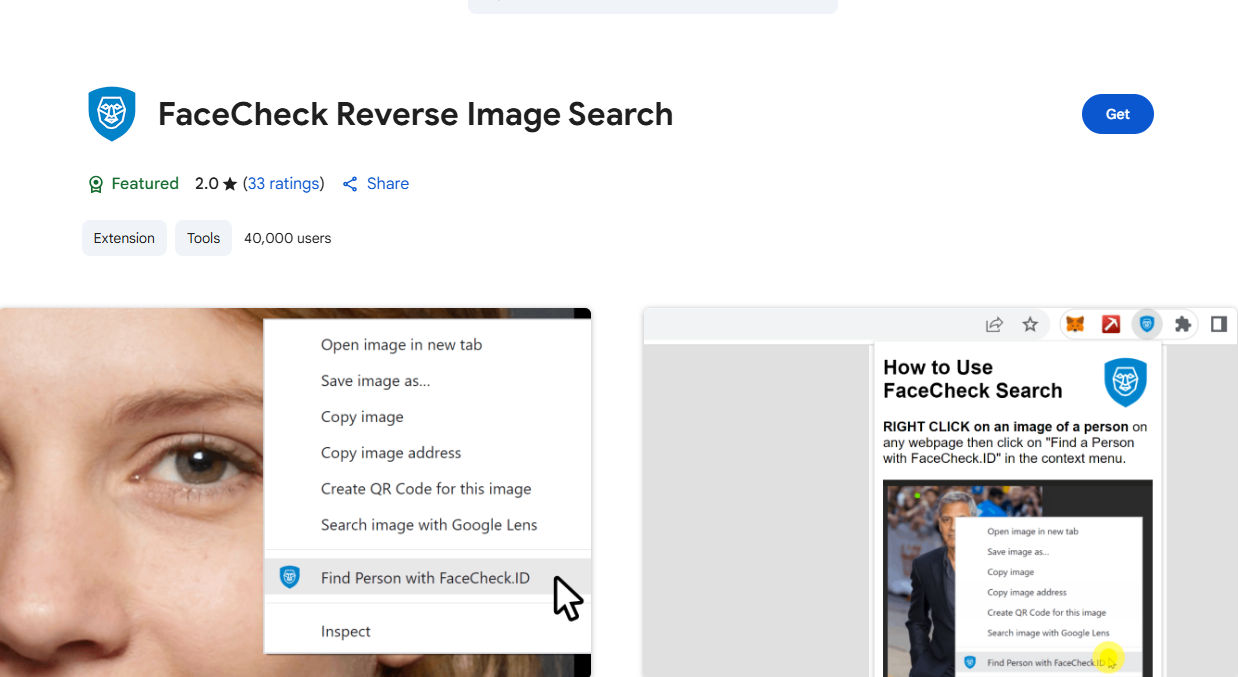
Facecheck is designed specifically for people search. If you want to combine face search with duplicate (copyright) image search, we recommend using the lenso.ai extension instead.
However, if you’re only interested in face search, Facecheck is worth trying.

Author
Julia Mykhailiuk
Marketing Specialist
Continue reading

News
Lenso.ai One-Time Payment: Reverse Image Search Without a Subscription
If you want to make unlocks on lenso.ai, but you don’t want to be tied to a subscription, here’s a solution you should consider: one-time payment. With one-time payments, you can purchase the product once, make unlocks and decide if you want to switch to a full plan later! This article explains how you can access the one-time payment and all the benefits it offers.

News
Using facial recognition and reverse image search for public security intelligence
Public security intelligence should implement and use only the best and most advanced tools that can help during the investigation process and provide support at different stages. How can facial recognition and reverse image search help?

News
How do Face Search Tools Work? Facial Recognition AI Models Explained.
Have you ever used a facial search tool and wondered how it works? In this article, we will explain the basics of facial recognition and tell you how face search websites build their own AI for face search engines.

News
Top 10 Reasons Why Lenso.ai Is the Best Face Search Tool Online
There are multiple facial search tools available on the internet. Most of them cost a lot, but do very little. Others provide low quality of results, show paywalls before the search even starts, or reel customers in by false advertising. Lenso.ai is the best facial search tool online, and here are some of the top reasons that prove it.

News
How Reverse Image Search Catches Stolen Before-and-After Photos in Home Service Marketing
A tree service in one state removes a storm-damaged oak, photographs the cleanup, and posts the before-and-after shots on Instagram. Eighteen months later, a company three states away is running the exact same photos as their own work on a Google Business Profile, cropped slightly and stamped with a different logo. Nobody at the original company notices, because nobody's looking. Nobody at the second company worries about it, because nobody's ever gotten caught.